Showing posts with label Philosophy Lecture. Show all posts

Wednesday, November 23, 2022

Presentation: Concept of Good Life in Indian Context


The good life is one in which what someone does and feels leads to and is constitutive of their fulfillment, also called happiness. Such happiness is neither primarily an experience; nor is it found as a consequence of following moral laws. Instead, happiness is fundamentally an activity: it is the state of the person who is living without hindrance the life that becomes a human being. The good life is the primary source of happiness. Here we will discuss the concept of the good life in the Indian Context.

Note:

Delivered a lecture on “Concept of Good Life in Indian Context” at “Centre of Excellence” Govt. Degree College, Sanjauli, Shimla on 23rd November 2022.

Thursday, April 8, 2021

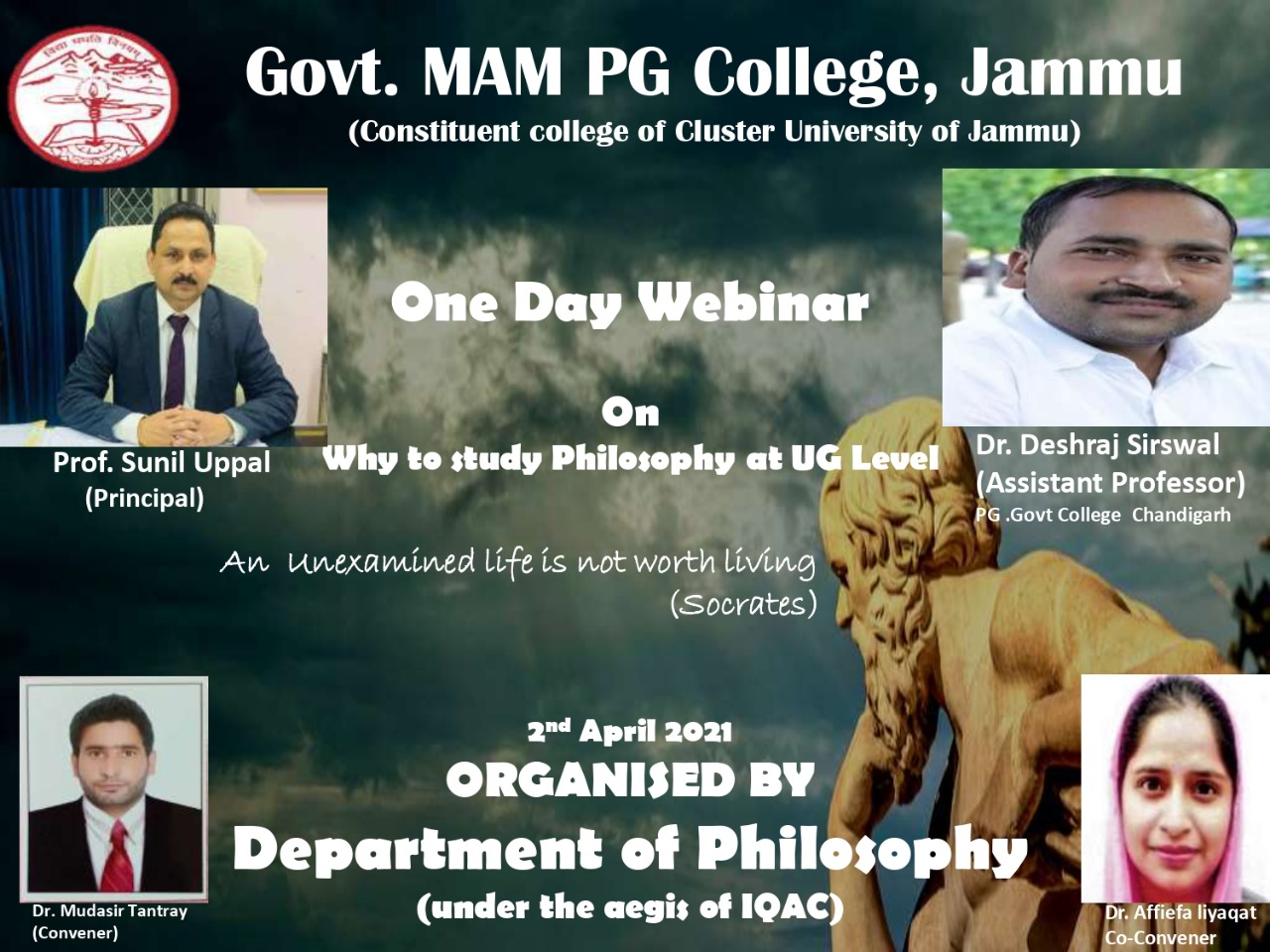
Lecture on "Why to Study Philosophy at UG Level ?"


 Philosophy is the study of general and fundamental problems, such as those connected with existence, knowledge, values, reason, mind, and language. “The unexamined life is not worth living,” said Socrates, one of our most enduring philosophers and thinkers. Being able to think critically and independently is an important skill that is often taken for granted. The serious study of philosophy as a major can prepare you to excel in any number of distinct, rewarding, and challenging careers. Philosophy is a multifaceted subject that has endless depth and potential to study and learn from for years to come. 


Note: Presented in One-Day Webinar on “Why to Study Philosophy at UG Level ?” at Department of Philosophy, Govt. MAM P.G.College, Jammu on 2nd April, 2021.


Link for full presentation:

https://www.researchgate.net/publication/350579455_Why_to_Study_Philosophy_at_UG_Level

Tuesday, October 2, 2018

Epicureanism, Charvaka and Consumerism: A Search for Philosophy of Happiness

Epicureanism, Charvaka and Consumerism:  A Search for Philosophy of Happiness
Dr. Desh Raj Sirswal


Abstract:
Epicurus was a Greek philosopher and more interested in pleasure or its pursuit than other ideals. He said, “No pleasure is a bad thing in itself, but the things which produce certain pleasures entail disturbances many times greater than the pleasures themselves.” Epicurus tells us that wisdom is the knowledge of which pleasures are good for us. While at times this led to a negative view of his philosophy, the reality is his thinking was very advanced and developed, leading to his ideas becoming highly influential in modern thought in many regions of the world today. His simple philosophies of avoiding pain, leading a simple life, and attaining knowledge have made his philosophy both attractive and influential to many.  One important Indian Philosophy “Charvaka” take this world to be the only reality.  Out of the four human values - Dharma, artha, kama, and moksha - they advocate pursuit of kama only and artha merely as a facilitating means for the purpose. For Charvaka, the goal of human life to attain the maximum amount of pleasure in this life, avoiding pain as far as possible. A good life is a life of maximum enjoyment. A good action is one which leads to a balance of pleasure and a bad action is one which brings about more pain than pleasure. In present times, consumerism is all pervading, the real spirit for any developing economy is to develop products and marketing practices advocating consumerism and it is inevitable to safeguard the interest of consumers at large. Consumerism is the belief that personal wellbeing and happiness depends to a very large extent on the level of personal consumption, particularly on the purchase of material goods. The idea is not simply that wellbeing depends upon a standard of living above some threshold, but that at the center of happiness is consumption and material possessions. It is an attempt of this paper to see the relation between these philosophies and try to find common characteristics which lead man to lead a happy and satisfactorily life.

Key-Words: Epicurus, Charvaka, Pleasure, Happiness and Consumerism.
Presented at National Seminar on CONSUMERISM AND CONSUMER PROTECTION IN THE ERA OF OPEN MARKETS IN INDIA (Sponsored by Panjab University, Chandigarh) PG Govt. College for Girls, Sector 11, Chandigarh on 30th January, 2018.

Monday, January 5, 2015

दर्शन, सृजनात्मकता और मानवीय सम्बन्ध (Philosophy, Creativity and Human Relations)


सारांश
मानवीय-सम्बन्ध सदियों से दर्शन और साहित्य के अध्ययन का मुख्य विषय रहा है.  जब भी हम मानवीय सम्बन्धों के विवेचन पर जाते है तब हम इनकी प्रकृति, व्यक्तिगत और सामाजिक सम्बन्धों की प्रमाणिकता के सम्बन्ध में बात करते हैं और हम केवल दार्शनिक विचारों तक ही  सीमित नहीं रहते बल्कि हमें मनोविज्ञानिकों, समाजशास्त्रियों, राजनीतिक विचारकों के साथ-साथ साहित्यकारों द्वारा दी गयी व्याख्याओं का भी अध्ययन करना पड़ता है क्यूंकि यह अन्तर्रविषयी अध्ययन का विषय है.  जब भी  मानवीय सम्बन्धों का दार्शनिक अध्ययन करते हैं  तो हमें   मानवीय प्रकृति, नैतिक मूल्यों, ज्ञान का क्षेत्र, राजनीतिक-स्वतन्त्रता और अनिवार्यता इत्यादि दर्शन के विभिन्न पहलुओं को भी समझना पड़ता है. प्रेम की प्रकृति (the nature of love), मित्रता (friendship), आत्माभिरुचि एवम अन्य (self-interest and others) , दूसरों से सम्बन्ध (relationships with strangers) और सामाजिक-सहभागिता  (social participation) इत्यादि इस अध्ययन की विषयवस्तु में सम्मिलित है. इस शोध-पत्र का मुख्य उद्देश्य दर्शन और सृजनात्मकता में सम्बन्ध और मानवीय सम्बन्धों  में इनकी उपयोगिता का अध्ययन करना है. 
Note:

This  paper  will  be  presented  at  the National Seminar on  “Moral Commitments, Responsibility and Human Relations" Society for Philosophical Praxis, Counselling and Spiritual Healing, Jaipur  to be  held on  21- 22 February, 2015, .


Wednesday, January 22, 2014

Philosophy and Values in Public Affairs: An Appraisal


Abstract

In the recent past, especially in the last quarter of 20th century, there have been drastic changes which have taken place. People all over the world, started feeling the pinch of “rate of change” in emerging contemporary society. It has influenced all the aspects of human life. It also influenced the ancient conception of philosophy that it seeks to understand the mysteries of existence and reality. It was also influenced by present scientific development which raised philosophical speculations towards linguistic analysis, mental content and later on cognitive science studies. It is true that philosophy tries to discover the nature of truth and knowledge and to find what is of basic value and importance in life. It also examines the relationships between humanity and nature and between the individual and society. Philosophy arises out of wonder, curiosity, and the desire to know and understand. Philosophy is thus a form of inquiry--a process of analysis, criticism, interpretation, and speculation. It is contributing in the process of human development since ancient times.  The process of human development begins with the conceptions and continues throughout life. It takes as many different courses as every human being develops in a unique way, embedded in the context of his or her environment. In the light of above assumptions, we are going to study the role of philosophy and values in public affairs and how philosophy shaping the human life with its continuous progress.

Note:
To be presented at National Seminar on PHILOSOPHY IN PRACTICE : MAKING SENSE OF HUMAN EXISTENCE, held on February 23, 2014 in the Department of Philosophy, University of Rajasthan, Jaipur

Monday, June 10, 2013

"कंटेम्पररी इंडियन फिलोसोफी " नामक पुस्तक का लोकार्पण


दर्शनशास्त्र  विभाग ,  कुरुक्षेत्र  विश्विधालय , कुरुक्षेत्र   के  तत्वाधान में एक  दर्शन-विषयक कार्यक्रम का आयोजन किया गया ,  जिसके मुख्य अतिथि प्रो. के. के. शर्मा (पूर्व  उपकुलपति , नेहू , शिल्लोंग ) और  अध्यक्ष प्रो. आर. के. देसवाल (अध्यक्ष, दर्शन शास्त्र  विभाग ,  कुरुक्षेत्र  विश्विधालय , कुरुक्षेत्र ) रहे। कार्यक्रम  के आरम्भ में कार्यक्रम सयोंजक डॉ  देशराज सिरसवाल  ने  2010   से वर्तमान तक की सेंटर द्वारा की गयी  गतिविधियों की जानकारी  दी। इस  अवसर पर सेंटर फॉर पॉजिटिव फिलोसोफी एंड इंटरडिसिप्लिनरी स्टडीज , पिहोवा  द्वारा प्रकाशित "कंटेम्पररी इंडियन फिलोसोफी  " नामक पुस्तक  का लोकार्पण किया गया , जो की सेंटर द्वारा प्रकाशित चतुर्थ पुस्तक और डॉ  देशराज सिरसवाल द्वारा सम्पादित है। 
प्रो. के. के. शर्मा  और  प्रो. आर. के. देसवाल ने कार्यक्रम में उपस्थित शोध-छात्रों को दर्शन की बारीकियों से अवगत करवाया और सार्थक जीवन के लिए महत्वपूर्ण मूल्यों की चर्चा की। कार्यक्रम के अंत में कई महत्वपूर्ण  विषयों पर चिन्तन  हुआ और शोध-छात्रों की  जिज्ञासाओं  का समाधान किया गया। इस अवसर पर डा अनामिका गिरधर (एसोसिएट प्रोफेसर,  दर्शनशास्त्र  विभाग),  डॉ सुरेंदर शर्मा(असिस्टेंट  प्रोफेसर,  दर्शनशास्त्र  विभाग), और राजिंदर कौर ,पूनम वर्मा , ईश्वर सिंह , विपिन   सांगर, मनोज कुमार , रामजवारी ,वन्दना , नीलम, वीनू इत्यादि शोध-छात्र एवम छात्राएं उपस्थित थे।  
  

Friday, April 27, 2012

Professional Ethics, Media and Good Governance


Professional Ethics, Media and Good Governance[1]
Dr. Desh Raj Sirswal
Abstract:
Philosophy is a vast subject and it is growing day by day in many branches although it has many traditional branches like epistemology, metaphysics, ethics and logic etc. Professional ethics is a discipline of philosophy and a part of subject called as ETHICS. In professional ethics we study the morals and code of conduct to be used while one practices in his/her profession. Media is also a profession and there is also a code of conduct to this profession better. If media professional be ready to work according to its professional ethics, he/she can have a good approach and it will direct him/her to play an important role in shaping good governance. In this paper it is an attempt made to draw a relation between all these conceptions and presents a theoretical interpretation of the above.


[1] Presented at UGC-Sponsored National Seminar on ‘Media and Governess ‘ held on 28th March,2012 at P.G.Govt. College for Girls, Sector-11, Chandigarh

Wednesday, December 7, 2011

E-book:Understanding Indian-Value System through Sri Aurobindo’s Education System


Understanding Indian-Value System through Sri Aurobindo’s Education System
(An online anthology of Sri Aurobindo's Ideas)
First Edition, December 06th 2011
Gitanjalee Bora
Research Scholar, Department of Philosophy, Gauhati University, Guwahati
Dr Desh Raj Sirswal
Assistant Professor (Philosophy), P.G.Govt. College for Girls, Sector-11, Chandigarh
Publisher:
Centre for Positive Philosophy and Interdisciplinary Studies (CPPIS), Milestone Education Society (Regd.), Balmiki Dharmashala, Ward No.06, Pehowa (Kurukshetra)-136128 (Haryana) Emails: mses.02@gmail.com, dr.sirswal@gmail.com
Can be downloaded from:

Monday, May 16, 2011

New Publication: POSITIVE PHILOSOPHY FOR CONTEMPORARY INDIAN SOCIETY


POSITIVE PHILOSOPHY FOR CONTEMPORARY INDIAN SOCIETY
Desh Raj Sirswal
**** eARTICLES FOR DOWNLOAD ****
eARTICLE SIZE: 489 KB; 38 pages; US$ 2
Ó Desh Raj Sirswal 2011

“Knowledge will forever govern ignorance; and a people who mean to be their own governors must arm themselves with the power which knowledge gives.” - James Madison
The 21st Century has been acknowledged as the 'Knowledge Century'. Every nation now finds itself operating in an increasingly competitive and globalised environment where the information, infrastructure, research and innovation systems, education and lifelong learning, and regulatory frameworks are crucial variables. In the words of Dr. Manmohan Singh, Prime Minister of India, “The time has come to create a second wave of institution building, and of excellence, in the fields of education, research and capability building so that we are better prepared for the 21st Century.” Since India’s independence, there has been a persistent demand on behalf of the country’s intellectuals, expressed in different professional, philosophical and non-philosophical fora, to re-examine both ancient and modern philosophical systems to evaluate them and derive from them new directives for today’s changing conditions and there is a definite impetus and a sense of need towards an independent Indian philosophical identity to reinforce research and philosophical studies in India at different levels.
Each step in the journey of human development adds new bench marks in it. I am working through Society for Positive Philosophy and Interdisciplinary Studies (SPPIS) Haryana since 2008. For me the meaning of Positive Philosophy is to achieve an intellectual detachment from all philosophical systems, and not only to solve specific philosophical problems, but also to become sensitively aware of what we do when have we philosophized. An Interdisciplinary Study is a field of study that crosses traditional boundaries between academic disciplines or schools of thought, as new needs and professions have emerged. Originally the term interdisciplinary is applied within education and training pedagogies to describe studies that use methods and insights of several established disciplines or traditional fields of study.
I think that in order to reach at the goal of creating “knowledge society”, the majority of the people in India must be helped to overcome ‘information poverty.’ The deprived peoples be given access to relevant and timely information and knowledge to address the roles they should play in the development process and in our society we are also working to erase information poverty related to philosophy discipline in India. It is painful situation that in India, philosophy is not more than a religious thinking for academic and non academic persons and no clear difference between study and teaching. So we should try to change our mental set and go for its practical implications. This is a reflection of my thoughts which are not complete yet it is my intention to get your response. I will be happy to get your comments, suggestions and will try to improve this work accordingly.
Positive Philosophy for Contemporary Indian Society has three chapters to read i.e. (i) Meaning of Positive Philosophy which deals with the conception of Positive Philosophy and Methodology, (ii) Nature of Philosophy in General which discuss about general conception of philosophy , methods of study and writing philosophy, and (iii) Philosophy of Social Change which discuss the need of Indian Model of Philosophy of Social Change and in the end there is a concluding remarks.
While going through this work, reader should not expect to find any final answer to the problems raised. This is not what philosophy aims at. In our country, there is an urgent need of those peoples who can think positively about humanities and social sciences for the growth of society and can make nation more competent with intellectual development. I would like to thank all friends and members of SPPIS, Haryana for their support and inspirational words.
DESH RAJ SIRSWAL: Assistant Professor (Philosophy), Post Graduate Govt. College for Girls, Sector-11, Chandigarh. He is also Programme Coordinator, Centre for Positive Philosophy and Interdisciplinary Studies (CPPIS), Milestone Education Society (Regd.), Pehowa (Kurukshetra). Associate Member of The Council for Research in Values and Philosophy, Washington, D.C.
Link for the Post: