Showing posts with label Indian Philosophy. Show all posts

Wednesday, November 23, 2022

Presentation: Concept of Good Life in Indian Context


The good life is one in which what someone does and feels leads to and is constitutive of their fulfillment, also called happiness. Such happiness is neither primarily an experience; nor is it found as a consequence of following moral laws. Instead, happiness is fundamentally an activity: it is the state of the person who is living without hindrance the life that becomes a human being. The good life is the primary source of happiness. Here we will discuss the concept of the good life in the Indian Context.

Note:

Delivered a lecture on “Concept of Good Life in Indian Context” at “Centre of Excellence” Govt. Degree College, Sanjauli, Shimla on 23rd November 2022.

Sunday, February 27, 2022

Presentation: Value Education: An Overview of Educational Initiatives taken in India


Abstract

The most effective strategy for building societal harmony and cohesion is education. India's national goals include internalizing secularism, supporting democracy, ensuring equality, pursuing national unity, revitalizing fraternity, and delivering social justice and liberty. The educational system must consider human needs, viewpoints, and desires. It must raise awareness of and respect for human rights and human values. The essential obligations outlined in Article 51(A) of the Constitution must be internalized by every child. The 42nd Amendment incorporated compassion, scientific temper, humanism, abjuring violence, and other fundamental duties into the Indian Constitution, including India's unity and integrity, harmony, spirit of common brotherhood, preservation of our composite culture's rich cultural heritage, compassion, scientific temper, humanism, and abjuring violence. These also highlight the need to improve and develop. In this paper an attempt is made to overview the educational initiatives taken for propagation of value education in Indian educational curriculum. 

Key-words: Value Education, Indian Education Policies, Constitutional Values, Indian Culture.

Note: Presented in Online Refresher Course on Indian Philosophy by CPDHE, UGC-HRDC, University of Delhi on 28th February, 2022.

Thursday, April 8, 2021

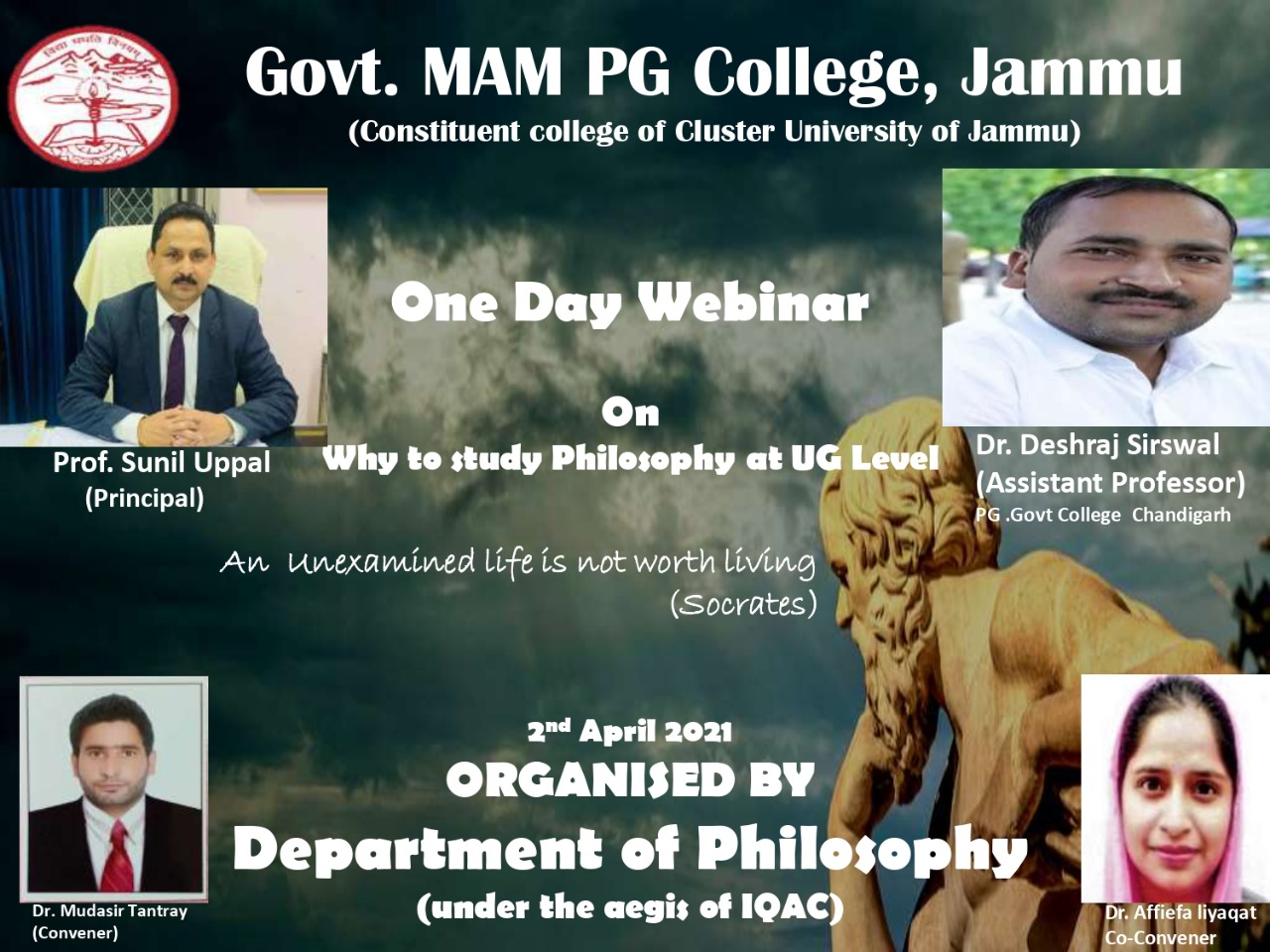
Lecture on "Why to Study Philosophy at UG Level ?"


 Philosophy is the study of general and fundamental problems, such as those connected with existence, knowledge, values, reason, mind, and language. “The unexamined life is not worth living,” said Socrates, one of our most enduring philosophers and thinkers. Being able to think critically and independently is an important skill that is often taken for granted. The serious study of philosophy as a major can prepare you to excel in any number of distinct, rewarding, and challenging careers. Philosophy is a multifaceted subject that has endless depth and potential to study and learn from for years to come. 


Note: Presented in One-Day Webinar on “Why to Study Philosophy at UG Level ?” at Department of Philosophy, Govt. MAM P.G.College, Jammu on 2nd April, 2021.


Link for full presentation:

https://www.researchgate.net/publication/350579455_Why_to_Study_Philosophy_at_UG_Level

Friday, February 22, 2019

हरियाणा में दर्शन एवम् लोकधर्म का विकास (Development of Philosophy & Folk Religion in Haryana)


 भारतवर्ष को दर्शन और धर्म की दृष्टि से विश्वपटल पर बहुत ही महत्वपूर्ण स्थान प्राप्त है. भारतीय समाज में धार्मिक विविधता के साथ-साथ हमें लोकधर्म की क्षेत्रीय स्तर पर हमें बहुत सी धाराएँ देखने को मिलती है. हरियाणा प्रदेश की भूमि को वेद, उपनिषद, महाभारत, पुराण, गीता आदि की रचना-स्थली भी माना गया है. इसे महाराजा हर्ष, सूरदास और बाणभट्ट जैसे महान व्यक्तित्वों की भूमि के साथ-साथ लोकभाषा का साहित्य का सृजनस्थल भी रहा है. लेकिन वर्तमान में हम वैश्वीकरण, सांस्कृतिकरण, और ब्राह्मणीकरण के चलते हम उन वैचारिक, सामाजिक और राजनैतिक प्रभाव डालने वाली संस्थाओं के महत्व को भूलाकर देश के सांस्कृतिक और दार्शनिक मूल्यों से दूर होते जा रहे हैं. प्रस्तुत लेख में हरियाणा राज्य में दर्शन और लोकधर्म के विषय पर प्रकाश डालना मुख्य उद्देश्य है.

Note:
Presented  “Development of Philosophy & Folk Religion in Haryana” in XX Conference of North-west Indian Sociological Association on Contemporary Issues in North West India: Challenges and Strategies organized by  Department of Sociology, Panjab University, Chandigarh held on 21-22 February, 2019.

Tuesday, November 22, 2016

Religious Practices and Democratic Values in India: A Search for Interreligious Dialogue


Abstract
India has a long, rich, and diverse tradition of philosophical thoughts, spanning some two and a half millennia and encompassing several major religious traditions. India’s democracy can be said to rest on the foundation of religious practice due to the practice of multi-religions and different sects in its continent. Religious practices ties among citizens that generate positive and democratic political outcomes if we see it from the ideals of any religious doctrine as per their written scripture. But in society religious practices (not religious doctrine) do not show equality and usually go against their own religious doctrine as preached in their religious places. It is also evident that religious denomination (Catholic, Hindu, Muslim, Sikh etc.) comes as a barrier when we practice democratic ideals in society and make social situation worst. How these religious practices contribute for a society where we can discuss the ideals of freedom, equality and brotherhood for a Just Society and become mean of interreligious dialogue in   multi-religious society? this is a big question to think .  The objective of this paper is to study the dimensions of religious practices in Indian society and how these practices can contribute in interreligious dialogue to make atmosphere of peace, understanding and harmony in the society.
Key-Words: Religion, Indian Society, Social Justice, Social Inclusion and Indian Constitution

Note:
To be presented at National seminar on World Religions: A step towards inter-religious dialogue sponsored by Indian Council of Philosophical Research (ICPR) New Delhi to be held at the Department  of Philosophy, Patkai Christian college, Nagaland.

Tuesday, September 27, 2016

भारतीय समाज में नैतिक मूल्यों की आवश्यकता


शोध-पत्र सार
भारतीय समाज मूल्यप्रधान समाज है. भारतीय संस्कृति में मूल्यों को मनुष्य के सामाजिक, राजनैतिक और धार्मिक जीवन में विशेष स्थान दिया गया है क्योंकि मूल्यों के वास्तवीकरण का नाम ही संस्कृति है. वर्तमान समय  में विज्ञान ने जहाँ मनुष्य को भौतिक सुविधाएँ उपलब्ध करने के लिए प्रत्येक क्षेत्र में अविष्कारों के ढेर लगा दिए हैं ,वहां उसके जीवन  में एक खोखलापन भी उत्त्पन्न कर दिया है. ऐसे में समाज, देश और अपने स्वयं के जीवन में उसने मानव मूल्यों को तिलांजली दे दी है. मानव जीवन की सार्थकता तभी है जब वह श्रेष्ठ भावनाएं रखे. हम एक लोकतान्त्रिक समाज का हिस्सा हैं जहाँ पर हम आपसी भाई-चारे, न्याय, समान अधिकार और स्वतन्त्रता का हिमायती बनने का नाटक करते हैं. संविधान में दिए गये मूल्यों की प्राप्ति से पहले हमें व्यक्ति के जीवन और समाज का भी मुआयना करना होगा तभी हम श्रेष्ठ मूल्यों को समाज में स्थापित कर सकते हैं. मूल्य, व्यक्ति की सामाजिक विरासत का एक अंग होता है इसलिए मूल्यों की व्यवस्था मानव आस्तित्व के विभिन्न स्तरों या आयामों में व्यक्ति के अनुकूलन की प्रक्रिया  का मार्गदर्शन करती है. नैतिक मूल्य व्यक्ति के जीवन के साथ साथ समाज को भी उत्कृष्टता की तरफ अग्रसर करते हैं. इस शोध-पत्र का मुख्य उद्देश्य नैतिक मूल्यों के व्यक्ति के जीवन  और वर्तमान भारतीय समाज में उपयोगिता का अध्ययन करना है. 

Note: To be presented at 12th Session of Darshan Parishad (MP & Jharkhand) to be held on 15-16 October, 2016 at Gwalior (MP).

Saturday, April 16, 2016

चार्वाकदर्शन के तत्व-सिद्धांत की वर्तमान प्रासंगिकता

(Relevance of Substance Theory of Charvaka in Present Times)
डॉ. देशराज सिरसवाल 


भारतीय चिन्तन परम्परा में पंच-महाभूत का बहुत महत्वपूर्ण स्थान है. भारतीय प्राचीन ग्रन्थों से लेकर अब तक विश्व की सरंचना सम्बन्धी सिद्धांतों में पंच-महाभूत सबसे स्वीकार्य सिद्धांत माना जाता रहा है. ये पांच तत्व हैं: पृथ्वी, जल, वायु, अग्नि और आकाश.  परन्तु चार्वाक जैसे दार्शनिक और आर्यभट्ट (पांचवीं शताब्दी) जैसे विज्ञानी यह कहते आ रहे हैं की तत्व पांच नहीं, चार हैं. इन लोगों ने आकाश को स्वतंत्र तत्व के रूप में स्वीकर नहीं किया. चार्वाक का यह भी विचार रहा है की सारा भौतिक व प्राक्रतिक परिदृश्य न किसी ने रचा है, न इसका कोई उद्देश्य है, प्रक्रति में परिवर्तन, विकास, रुपनान्तरण आदि इसकी अपनी प्रकिया है जो तब भी लाखों करोड़ों वर्षों से हो रहा था और आज भी विभिन्न रूपों में हो रहा है. पंच-तत्व के सिद्धांत को मानने वालों का विचार है की इन पांच तत्वों से जब शारीर बनता है तब आत्मा बाहर से प्रविष्ट होती है जबकि चार तत्व को मानने वाले चार्वाक का कथन है की इन चरों तत्वों के विशेष रूप में परस्पर मेल से ही चैतन्य (चेतना ) की उत्पत्ति होती है, आत्मा कहीं बाहर से नहीं आती- भूतेभ्य: चैतन्यम.आज विज्ञानं बहुत आगे बढ़ गया है और चार्वाक उसके अनुसार नये तत्वों की बात करते हैं. वास्तविकता तो यह है की जिन्हें हम तत्व कह रहे हैं वे तत्व न होकर यौगिक या मिश्रण हैं.  तत्व वह होता है जिसमें एक तरह कर परमाणु रहते हैं और जिसे सरलतम पदार्थ के रूप में विभाजित नहीं किया जा सकता. चार्वाक प्रकृति के जड़ रूप से ही, भौतिक तत्वों से चैतन्य की उत्पत्ति को मानता है. जैसे किनव, मधु और शर्करा आदि के मिलने से मादकता उत्पन्न होती है  उसी प्रकार शरीर में चैतन्य की उत्त्पति होती है. जब भौतिक तत्वों का तालमेल बिगड़ जाता है तो चैतन्य भी खत्म हो जाता है- सदा के लिए, सर्वदा के लिए – भस्मीभूतस्य देहस्य पुनरागमन कुत:.चार्वाक का कहना है की चैतन्य आत्मा काआकस्मिक गुण नहीं बल्कि मौलिक गुण है और चैतन्ययुक्त शरीर ही आत्मा है . यद्यपि आज चार्वाक के चार तत्व भी आदर्शवादियों के पांच तत्वों की तरह ही रद्द हो चुके हैं तथापि उनकी स्थिति दूसरी है. उन्होंने चार तत्वों को प्रकृति के प्रतिनिधि कह कर इन से चेतना की उत्पत्ति मानी है, प्रकृति एकतत्ववाद का उनका सिद्धांत आज विज्ञानसम्मत सिद्धांत है, भले ही उन की तत्वों की बात तकनीकी रूप में सही न हो. उनके लिए चार तत्वों को मानना न अनिवार्य है और न ही उसे मानने के लिए कोई ईश्वरीय आदेश है क्योंकि तत्व उनके लिए प्रकृति के प्रतिनिधि मात्र हैं, जो तब यदि चार थे तो आज 118 हैं. इससे उन्हें कोई फर्क नहीं पड़ता जबकि अन्य दर्शनों के लिए के लिए स्वीकार करना दुरूह है. अत: हम कह सकते हैं की चार्वाक का दर्शन अनात्मवादी, प्रत्यक्षवादी और भौतिकवादी है. अत: इस शोध-पत्र का मुख्य विष्ण पंच-महाभूतों की अवधारणा की चार्वाक के सन्दर्भ में समीक्षा करना है और चार्वाक दर्शन की आज की प्रासंगिकता को देखना है.
Note: This paper presented in One-Day National Seminar-cum-Panel Discussion on "Science of Panch-Mahabhoots and Consciousness" at S.D. College (Lahore) Ambala Cantt. Haryana held on 16th April, 2016.

Friday, March 4, 2016

Essays on Positive Philosophy (New E-book)


Released on 23rd March,2016
You can see the book on the given below link and also see previous published books:
http://www.amazon.in/s/ref=dp_byline_sr_ebooks_1?ie=UTF8&text=DESH+RAJ+SIRSWAL&search-alias=digital-text&field-author=DESH+RAJ+SIRSWAL&sort=relevancerank

Thursday, December 31, 2015

MY ACADEMIC REPORT- 2015


Dear Scholars/Friends,
I am submitting my academic report for the year 2015 as an regular practice every year. This helps me to evaluate my academic contribution per year and motivate me to do more………..
Papers Published: 05
§  “The Philosopher King: An Indian Point of View” in Sucharitha: A Journal of Philosophy and Religion, Volume 03, Issue 01, 2015, pp.12-19.  (ISSN: 2319-4235).a
§  Positive Philosophy, Innovative Method and Present Education System” in Intellection: A Bi-annual Interdisciplinary Research Journal, Vol.III, No.II, July- December 2015, pp.01-13 (ISSN:2319-8192).
§  “Place of Logic in Indian Philosophy” in Lokāyata: Journal of Positive Philosophy, Volume V, No. 02 , September, 2015, pp.39-49 (ISSN: 2249-8389).
§  “Positive Philosophy of Swami Brahmananda Saraswati” in Darshan Jyoti: Refereed Annual Philosophical Research Journal, Year 05, No.01, September, 2015-August-2016, pp. 124-130 (ISSN: 2249-1196).
§  “Public Service Values and Ethics in Public Administration” in The Religious-Philosophical Dimensions edited by Merina Islam, CPPIS, Pehowa in 2015, pp. 109-122 (ISBN: 978-81-922377-5-6).
Papers Presented: 04
·      “Crime against Dalits and Indigenous Peoples as an International Human Rights Issue” in One-Day National Seminar on "Human rights for the marginalized groups: Understanding & Rethinking Strategies" held on February 5, 2015 at P.G. Govt. College for Girls, Sector-11, Chandigarh.
·      “Dr. B.R.Ambedkar’s Contribution in the Democratic Rights Struggle” in National Seminar on Dr. B.R. Ambedkar’s Views on Social Justice, Caste based Discrimination and Dalit Identity held on March 27-28, 2015 at Dr. Ambedkar Centre of Socio-Economic Studies for the Weaker Sections of Society and CSSEIP, Panjab University, Chandigarh.
·      “Philosophy, Creativity and Human Relations”  in  60th Annual Session of All India Philosophy Association held on  3rd – 5th June 2015 at School of Philosophy & Culture, Shri Mata Vaishno Devi University, Katra, Jammu & Kashmir.
·      “The Role of Religious and Spiritual Values in Shaping Humanity ( A Study of Dr. B.R. Ambedkar’s Religious Philosophy) in 3rd International Dharma-Dhamma Conference on Harmony of Religions: Welfare of Humankind, held on 24-26 October, 2015 at Indore (MP).
Participations:02
o   RUSA Sponsored Seven Days Training Workshop on “Research Methodology: Emerging Trends”  held on November 28 to 04 December, 2015 at P.G.Govt. College for Girls, Sector-42, Chandigarh.
o   Three-Day Philosophy Teachers' Meet of North-Western Zone sponsored by ICPR, New Delhi, Department of Guru Nanak Studies, Guru Nanak Dev University, Amritsar on 29th to 31st Dec. 2015
Citation Received: 01
·      Dr. Laxmikant Sharma (2015)  “Dr. Ambedkar’s Vision on Indian Farming” in International Journal of Research in Commerce & Management, Volume No. 6 (2015), Issue No. 01 (January) (ISSN 0976-2183), p.27. (Sirswal Desh Raj(2010): Dr. Ambedkar's Views on Humanism and Buddhism" in Dr. R. B. Langayan(ed.) Relevance of Thoughts of Dr. Ambedkar in Present Times, Vishal Kaushik Printers, Delhi. ISBN-978-81-89495-41-1.) Link: http://ijrcm.org.in/ download.php? name= ijrcm -1-IJRCM-1_vol-6_2015_issue-01-art-06.pdf&path=uploaddata/ijrcm-1-IJRCM-1_vol-6_2015_issue-01-art-06.pdf
Online Article: 05
·      69वें भारतीय स्वतन्त्रता दिवस-2015 की हार्दिक शुभकामनायें
·      भारत रत्न डॉ भीमराव अम्बेडकर जी के जन्मदिवस पर विशेष-2015
·      अंतर्राष्ट्रीय महिला दिवस पर हार्दिक बधाई
·      गांधी बनाम गोडसे बनाम लोकतंत्र
The above short articles available at:
http://msesaim.wordpress.com/
Programme Organised:03
  • ICPR Sponsored Periodical Lectures at Department of Philosophy in academic collaboration with Department of Hindi, P.G.Govt. College for Girls, Sector-11, Chandigarh held on 11-02- 2015.
·      “World Philosophy Day-2015” at Departments of Philosophy & Hindi, P.G.Govt. College for Girls, Sector-11, Chandigarh held on 19-11-2015.
·      An Online National Level Essay Competition for Students on the theme “Dr. B.R. Ambedkar: The Maker of Modern India” at Centre for Positive Philosophy and Interdisciplinary Studies (CPPIS), MSES (Regd.), Pehowa (Kurukshetra) held on 19-11-2015 (World Philosophy Day).
Membership: 01
·      Life-Member, All India Philosophy Association (Akhil Bhartiya Darshan Parishad): 03/06/2015.
Online Pages Developed: 01
·      Dr. B.R. Ambedkar: The Maker of Modern India (Celebrating 125th Birth Anniversary of Dr. B.R. Ambedkar):  http://drambedkar125.wordpress.com
Posters: 03
·      Happy Teachers’ Day 2015 -The Positive Philosophy Society
·      Happy Teachers’ Day- CPPIS, Pehowa
·      Word Philosophy Day-2015
Journal Issues:03
·      Lokayata Vol.IV,No.01 (March  2015) edited by Desh Raj Sirswal
·      Lokayata Vol.IV,No.02 (Sept  2015) edited by Desh Raj Sirswal
·      Milestone Education Review Year 06, No. 01 edited by Desh Raj Sirswal
Videos uploaded: 05
·      Birth Anniversary Celebration of Savitribai Phule: Jan 07, 2015
·      Academic  Programmes (2010-2014) Department of Philosophy, PGGCG-11, Chd: Jan 08,2015
·      Student Activities (2010-2014) Department of Philosophy, PGGCG-11, Chandigarh: Jan 09,2015
·      Sweet Memories of Milestone Education Society (2006-2011): Jan 14,2015
·      Nomination of Prof. Sohan Raj Tater for “Padam Shri Award”: Jan 17,2015
Videos can be watch at:
https://www.youtube.com/user/cppismedia                                            
Additional Work:
In addition to the abovesaid, I submitted several reports of the programmes, prepared new online profiles regular updated all our philosophy pages including Philosophy News in India, The Positive Philosophy, Indian Psychology, Interdisciplinary Studies, Scribd.com, Research Gate, Academia.edu, Issuu.com etc.  Some assignments are pending for the next year:
·      Essay in Positive Philosophy (Book)
·      Dr. B.R.Ambedkar :The Maker of Modern India (Edited Book)
·      Two issues of Milestone Education Review will be on Dr. B.R. Ambedkar.
·      Philosophy of Sufism and Islam (Research Paper)


Hope your blessings, motivation and good wishes guide me in my academic career and social life in future also.
Thanks for being with me.
Dr. Desh Raj Sirswal

December 31, 2015